Now a reality…
Note: LG Electronics is a High Road Communications client. I don’t work on the account. But I’d love to try out that watch phone…
a personal blog about technology, communications and other stuff that interests me

Now a reality…
Note: LG Electronics is a High Road Communications client. I don’t work on the account. But I’d love to try out that watch phone…
For the upcoming StartupEmpire conference in Toronto, we shot a few short videos with Mike McDerment, CEO of FreshBooks. In the videos, he talks about his experience as a startup entrepreneur here in Canada.
The first one is about blogs and marketing: All you need is a blog to market your product? You’re so wrong. More videos next week.
(High Road Communications is a sponsor of StartupEmpire)
Here’s a video of Jevon MacDonald and David Crow talking about the upcoming StartupEmpire conference in Toronto on November 13 and 14. It’s a Canadian conference “from entrepreneurs for entrepreneurs”.
StartupEmpire already has an amazing lineup of speakers including Don Dodge, Hugh MacLeod, Howard Lindzon, David Cohen, Austin Hill, Leila Boujnane, Lane Becker and Charlie O’Donnell. Watch the video for Jevon and David’s perspective on what they want to accomplish with the conference.
More information is available at www.startupempire.ca and on David and Jevon’s blogs.
Disclaimer: High Road Communications is a sponsor of the conference.

When he’s not busy educating Toronto geeks on fashion style, David Crow dedicates a lot of his time to organizing and participating in tech community events.
 Now I just came across the Founders and Funders event, which he and Jevon MacDonald of StartupNorth are bringing to Toronto on June 4 – for the second time.
Started in Montreal last November, Founders & Funders is about “helping to connect the founders of early-stage, venture fundable web and technology companies with the funding community in Canada.”
Sounds like a great concept to me.
Founders & Funders is a private, invite only social event.
Founders and Funders is dedicated: to helping Canadian entrepreneurs to meet each other; meet potential funders: angel, VC or other money sources; to have fun; and see how we can help each other create the NEXT BIG successful company.
More information about the June 4 event can be found here.
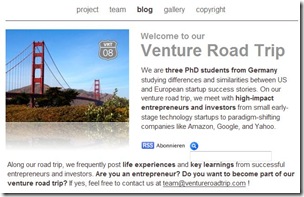
Stephen Rouse over at IGLOO gave me a heads up on a new blog that tries to explore the “differences and similarities between US and European startup success stories”. Created by three German PhD students who currently travel through the United States, Ventureroadtrip.com profiles entrepreneurs and investors in short video clips.
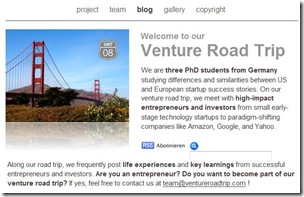
Ralf Schmelter, Carsten Ruebsaamen and René Mauer use the blog to capture some of the impressions from their research trip. For now they mostly seem to focus on short video profiles of startup companies. Once the research phase is over, I hope they will also share some of their insights and observations on emerging patterns/trends with us.
Ralf, Carsten and René are still looking for more entrepreneurs to participate in their research. For anyone who is interested, head over to Ventureroadtrip.com to get in touch with them.
Here are two quotes from newspaper articles about email overload in the workplace.
It seems that people are so busy wading through the overload and responding that they don’t have time for real work. […] A few companies are taking corrective action. Computer Associates, based in Islandia, L.I., shuts down its E-mail system for four hours a day, between 10 A.M. and noon and again between 2 P.M. and 4 P.M. “People were spending too much time on E-mail,” said Marc Sokol, vice president of advanced technology. “We said, ‘Use it intelligently, don’t use it spuriously.’ ” Until employees got used to the restrictions, Mr. Sokol said, they found the experience similar to quitting smoking. Now, he added: “Productivity is up. It has caused people to be more thoughtful.”
wit’s end: Coping With E-Mail Overload, The New York Times
Overwhelmed by e-mail? Some professionals are fighting back by declaring e-mail-free Fridays — or by deleting their entire in-box. Today about 150 engineers at chipmaker Intel will kick off “Zero E-mail Fridays.” E-mail isn’t forbidden, but everyone is encouraged to phone or meet face-to-face. […] E-mail-free Fridays already are the norm at cell carrier U.S. Cellular and at order-processing company PBD Worldwide Fulfillment Services in Alpharetta, Ga.
Fridays go from casual to e-mail-free, USA Today
The biggest difference between the two quotes? Eleven years.
The New York Times article is from April 1996, the USA Today article from October 2007. Apparently not much has changed in all those years, even though “experts” were already hoping for better times in 1998:
Despite the e-mail glut problems, there is optimism among e-mail experts that new solutions – both technological and behavioral – will keep pace with higher e-mail volumes.
E-mail overload drives many users bananas, NetworkWorld Fusion (via CNN.com)
Ten years later, the technological and behavioural solutions still haven’t fully caught up with the ever increasing volume of email (numbers are up from 15.1 billion in 2000 to 97.3 billion emails per day in 2007 according to IDC research quoted in the USA Today article). Otherwise we wouldn’t continue to see the same type of email overload articles year after year after year.
No doubt email overload has been and continues to be a problem for many people. Just this weekend I read a another article (in German) about a German company prohibiting email use two days a month. But I am not a big fan of organized email prohibition, whether it is a top-down decree by the company leadership or a bottom-up idea from a group of employees.
In the end, every individual needs to take charge of how they best manage their communication – every day of the week.
Because it gets worse. Thanks to other changes in technology and behaviour, (yep, I am talking about that Web 2.0 thing and the rise of, you guessed it, social media), email overload articles are not alone anymore. We now have journalists and a whole blogosphere continually discussing the potential benefits or repercussions of using blogs, RSS feeds, Facebook, LinkedIn, Twitter and all the other tools for communication. How do we keep up with all of this if email management still is a problem? Will we still have a social media overload discussions in eleven years?
“There’s going to be a point where culture and common sense are going to start to take over,” [Rapport Communications consultant Gary] Rowe said, “because there’s only so much of this we can process.”
E-mail overload drives many users bananas, NetworkWorld Fusion (via CNN.com), June 1998
My guess is that every person needs to find that point for herself or himself. I wouldn’t wait for your company or colleagues to do it for you.
A friend of mine for years refused to get her own cell phone even though she saw many of the benefits. She argued that “once people know I have it, they will expect to reach me 24/7”. I never bought that argument (but she eventually bought a cell phone). A cell phone can be switched off. Email – and expectations – can be managed by ourselves. And so can social media tools.
Overload, more often than not, is a fact. But it can also be a state of mind.
From the TED conference:
"Science educator Roy Gould and Microsoft’s Curtis Wong give an astonishing sneak preview of Microsoft’s new WorldWide Telescope — a technology that combines feeds from satellites and telescopes all over the world and the heavens, and weaves them together holistically to build a comprehensive view of our universe. (Yes, it’s the technology that made Robert Scoble cry.)"
(found via Don Dodge’s blog | client disclaimer)