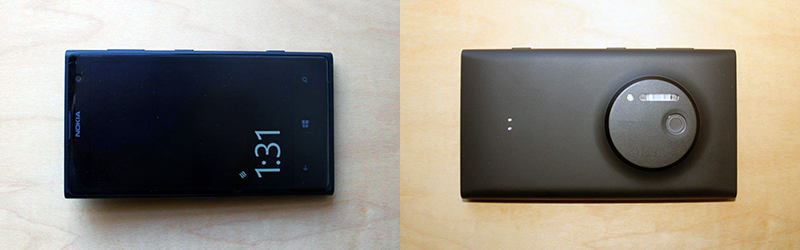

After switching from an iPhone 4S to a Nokia Lumia 1020 with Windows Phone 8 a few weeks ago, friends asked me about my first impressions. My short answer was: if phones were like dogs, I’d say I moved from an aging, elegant showdog to a big, friendly St. Bernard.
Here’s why I made a move. I wanted a bigger screen and a better camera and use the faster LTE network. I liked the 4S but I thought it’s a good time to try something new and take a chance on the Lumia 1020.
Since I am already irrational and biased about the two football clubs I support, I don’t need these types of discussions about the phone I use. What follows is my personal impression of the Lumia 1020 for the friends who asked. It is not a purchase recommendation for everyone. If you would like to read another perspective on the Lumia 1020, check out Paul Thurrott’s review here.
Look & Feel
It’s not a looker. It is big and the protruding lens makes the backside look more like a compact camera than a smartphone. If I had to pick a category, it would be “productivity tool” over “lifestyle product”.
That said, the Lumia is comfortable to use. Although it looks heavy, it doesn’t feel that way to me. The small bump on the back for the lens was barely noticeable after only a day of use. Lying on a tabletop, the lens puts the phone at a slight angle which is a little weird but actually improves reading.
The 4.5 inch screen size of the Lumia is ideal for me because there’s a lot of screen real estate and I can still easily use it with one hand. People with smaller hands will probably use both hands more often.
Camera
Although it’s been a few weeks now, I haven’t properly tried out the camera. So far I can say that the quality of photos is good and that it works really well in low light.
While the camera functions well in “automatic” mode, there are a lot of settings that make a difference, and understanding them matters for the quality. For example, at first I couldn’t get the camera to focus properly for close up shots. When I manually changed the “focus light” setting in the camera app to “off”, it worked beautifully. I am hoping to work my way through all of the camera details in the next little while.
If you want to see examples of what the Lumia 1020 is capable of, take a look at the photos on the National Geographic website and this review by a professional photographer.
Here is also a music video by Ellie Goulding shot entirely on the Lumia 1020. Given that the video and the National Geographic photos were created by professionals in collaboration with Nokia, this may not be a good example of everyday usage. But I do think it shows what the camera in this phone is capable of.
Apps
The Windows Phone 8 platform is not for people who always want the latest and greatest in apps. For me, fewer apps are okay. After three years of using an iPhone, I had accumulated almost 200 apps and my iTunes felt like a big app graveyard. The question, of course, is which apps do you really need? There are maybe five apps that I absolutely need and another ten that are really nice to have.
I use my phone for work, and I was surprised how much I liked the way email, calendar and tasks work on the Lumia 1020. I use Microsoft Office on my computers, and Windows Phone 8 is a good extension of the desktop and laptop experience, including Skype and Lync. Gmail also works fine but for people heavily invested in the Google or Apple ecosystem, this isn’t the right phone. I actually do feel more productive with this phone. I also like some of the little things, like the people view that shows you interactions with people in your contact list across phone, email and social media channels.
The Xbox Music app looks nice but some of the navigation isn’t intuitive. It’s okay to use but as a heavy listener of music, I hope to see improvements. I do love the monthly Xbox Music subscription because it allows me to listen to music I like but don’t want to own forever. There are also a few Nokia apps that are well worth using. In addition to the camera apps, I do enjoy Nokia’s HERE apps Drive+, Transit, Maps and Explore Beta.
I would not have tried the Lumia without the availability of Evernote. Because I use it a lot on my computers, I was quite worried about the Evernote app for Windows Phone 8. The good news: it does work well, and I prefer the user experience to the new iOS7 version. There are a few small things that are annoying. For example, notes can only be created and edited in portrait mode. Landscape mode is not enabled. I hope this get fixed soon.
There are many apps that are great and a lot that are equal to iOS or Android. For example, I didn’t see any difference in my usage of Facebook (Beta) on WP8 compared to iOS. Twitter is fine too. Other apps, like LinkedIn for WP8, are clearly inferior and you get the feeling they were developed as an afterthought. For LinkedIn I often just go through the full website, which is still okay to use on the 4.5 inch display. That is a clear difference to my usage of the iPhone 4S. In this case, size does matter.
And then there are apps that are missing. For example, my bank here has an app for iOS but not WP8; same for Air Canada. But both the bank and the airline have mobile web apps. They don’t look great, to say the least, but I can still make transactions and get the info I need. Kobo doesn’t have a native WP8 ereading app but Kindle does. Since I was already using both on my iPhone, I will just buy more books on Kindle until Kobo steps up. And it is possible to read Kobo books on the Lumia using the Kobo Instant Reader (HTML 5).
Overall, it is clear that WP8 typically is not the primary mobile development platform. Many first or third party apps are available, and most are either as good or better than on other platforms. Having to use a work-around for some missing apps isn’t great. But it doesn’t bother me all that much.
But so far, I am not really missing any key apps. That may change, of course, and I am still only starting out with this phone. Ask me again in three months. At the same time, it seems that more apps become available. It is something to watch over the coming year. Hopefully traction for WP8 will continue to grow as it has in a number of countries over the last few quarters.
If app availability is a key consideration, though, this phone may not (yet) be for you. Which is a shame because it is great to use. If you do use it primarily as a phone and for messaging, email, calendar, task, reviewing/editing documents and images, music, web surfing and some social media services, it works really well. It’s a phone to get stuff done.
Other Observations
I like that the new Lumia has a micro USB port. It means I only need one charging cable for my phone, and the Bluetooth headset and digital recorder I typically carry around with me.
At first I was disappointed that the virtual keyboard doesn’t stretch across the full width of the screen in landscape mode but I was surprised how well I was able to type on it in both portrait and landscape. Voice dictation of emails is a useful feature, as I found out while running down Bay Street in a hurry. Phone and texting functions are good too.
My Lumia came with Nokia earphones that also had a built-in microphone and a button to stop/start music or answer phone calls. Call quality was surprisingly good but I replaced the Nokia earphones with a-JAYS Five for Windows, which give me full volume, track and phone functionality. They also sound better and I much prefer wearing them. They cost a little over $100 but given the amount of time I spend using the Lumia for phone calls and to listen to music, I found it a worthwhile investment (just like I used Klipsch earphones for the iPhone).
Finally, switching to a phone that uses the LTE network was a good move. I do notice the speed difference (compared to 3G on the iPhone 4S). I am also getting better reception inside my home and in other places, although I am not sure whether that is due to the difference in the phones’ antennas or the difference between networks.
Overall, I do like both Nokia’s Lumia hardware and Windows Phone 8 as platform. If the camera isn’t as important to you, there are a number of other Lumia phones with really good cameras but without the protruding lens.
So there you have it: my impressions of the Nokia Lumia 1020 after a few weeks of using it exclusively. So far I am really happy with it. I still have my old iPhone 4S as a backup phone but haven’t seen the need to turn it on again so far. One of the biggest reasons for buying the Nokia Lumia 1020 was the camera. I haven’t really had the chance to fully explore it yet, so I may post an update in a few months. Stay tuned.